Reflection Takes On China's Open Models
Plus, How to connect Shopify to ChatGPT and run your store from a conversation, Only 4.5% of Americans pay for a major AI chatbot, and more!

Hola Decoder😎
If someone forwarded this to you and you want to Decode the power of AI and be limitless, then subscribe now and Join Decode alongside 30k+ code-breakers untangling AI.
⚡ Reflection wants Beam to become the open model companies run themselves
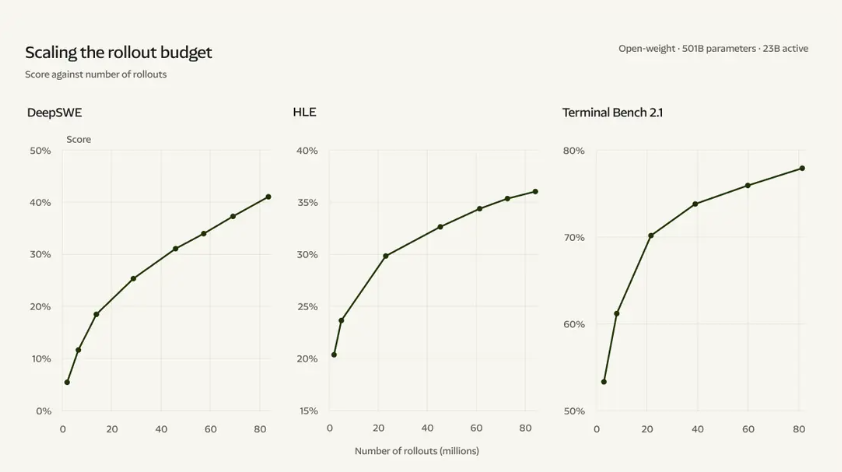
Reflection AI has introduced Beam, a 501B-parameter open-weight model for coding, reasoning, and AI agents. Despite its size, its Mixture-of-Experts architecture activates only 23B parameters at a time.
The Shift:
Built to Use Less Compute - Reflection says Beam delivers reasoning and coding performance comparable to Z.ai’s GLM-5.2 while using 3–4x less inference compute, making efficiency one of its main advantages.
China Still Holds the Lead - Moonshot’s Kimi K3 remains ahead on raw capability, but Reflection says Beam beats Thinking Machines’ Inkling and other U.S. open models in its own evaluations.
Trained at Massive Scale - Beam was pretrained on 23.8T tokens, then underwent four weeks of reinforcement learning across 10,500 Nvidia GB300 GPUs, producing more than 100M rollouts.
Companies Can Own the Model - Reflection plans to release Beam’s weights this month under an Apache 2.0 license, allowing organizations to customize and run it themselves instead of sending sensitive data to an external AI provider.
Reflection’s bigger goal is what it calls “AI factories”: companies, hedge funds or governments running models like Beam on their own chips and private data. A reported test is already underway in South Korea, positioning Beam as infrastructure organizations can own and customize rather than simply access through an API.
Together with Omnisend
What Happened to Everyone Who Bought Last Black Friday?

Before you spend more bringing new shoppers in, what happened to the people who bought last Black Friday? Some haven’t returned. Your next campaign could give them a reason to.
Omnisend’s BFCM AI playbook shows you how to turn customer and campaign data into work you can use this season:
- Find past BFCM buyers who haven’t purchased again and build a dedicated audience.
- Identify the offers behind your strongest campaigns to inform this year’s calendar.
- Check welcome and abandoned-cart emails for weak spots before holiday traffic arrives.
With Omnisend connected to Claude or ChatGPT, you can create segments and editable email templates from the conversation. Review them in Omnisend before sending.
The email and SMS platform serves 150,000+ brands, and you can start free without a credit card.
Use the prompts now, while there’s time to address what you find before your busiest selling weekend.
🛍️How to connect Shopify to ChatGPT and run your store from a conversation
No dashboards. No digging for numbers. ChatGPT connects directly to your store and acts on real data.
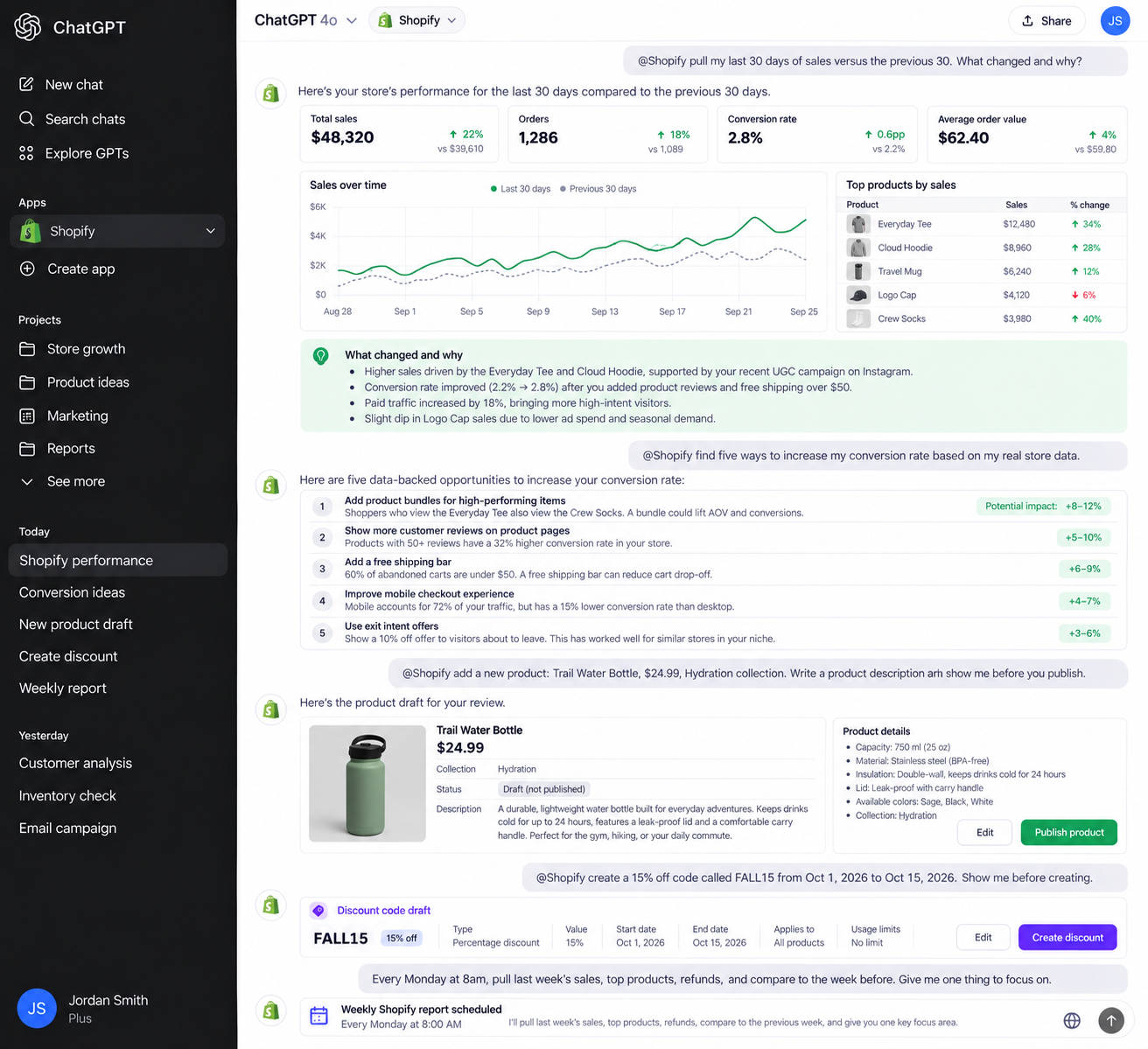
Step 1: Connect your store - Apps > Search Shopify > Connect. Log in, choose your store, approve access. Under a minute.
Step 2: Pull your numbers - "@Shopify pull my last 30 days of sales versus the previous 30. What changed and why?"
Step 3: Find where you're losing sales - "@Shopify find five ways to increase my conversion rate based on my real store data."
Real analysis from your actual orders, not generic advice.
Step 4: Add products and create discounts without opening Shopify - "@Shopify add a new product: [name], [$price], [collection]. Write a product description and show me before you publish."
"@Shopify create a 15% off code called [CODE] from [date] to [date]. Show me before creating."
Always ask it to show you before publishing anything.
Step 5: Automate your weekly report - "Every Monday at 8am, pull last week's sales, top products, refunds, and compare to the week before. Give me one thing to focus on."
Set as a scheduled task. Runs every Monday automatically.
💰 Only 4.5% of Americans pay for a major AI chatbot
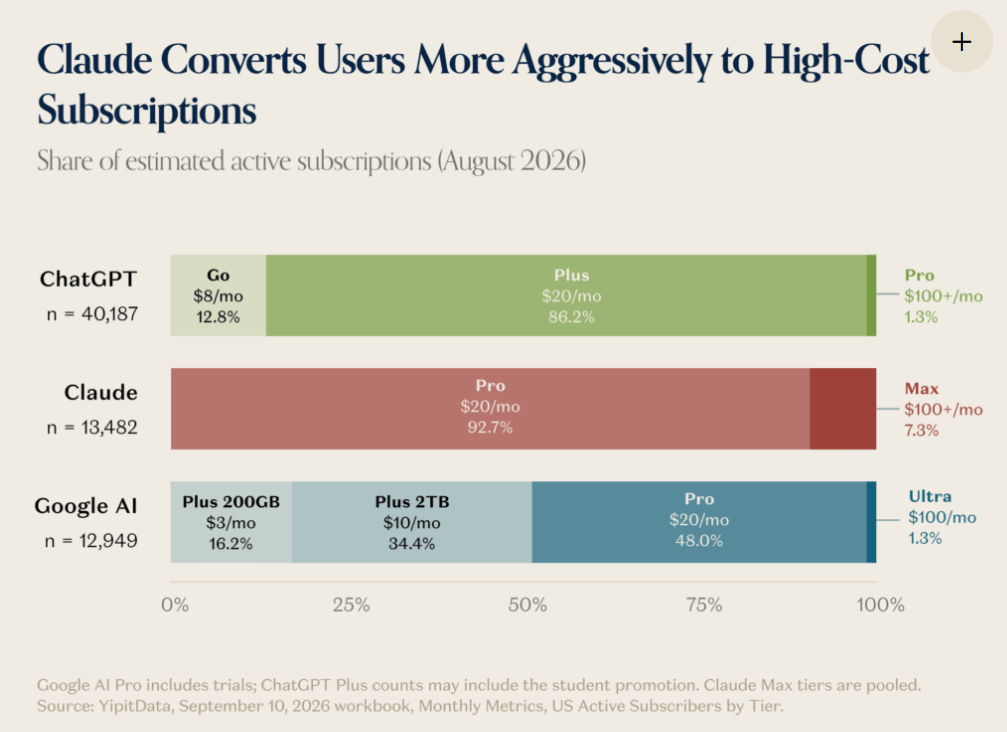
Andreessen Horowitz’s latest Top 100 Gen AI Consumer Apps report adds a new ranking based on U.S. card spending, revealing who is actually paying for AI and where that money is going.
The Shift:
ChatGPT Leads Paid AI - ChatGPT has roughly 3x as many U.S. paid subscribers as its rivals. Claude caught up with Gemini this summer and is showing strong monetization among higher-paying users.
AI Spending Is Extremely Concentrated - Just 4.5% of Americans subscribe to a major chatbot. Among paying users, the top 1% spend an average $903 per month, collectively spending more than the bottom half.
Power Users Buy AI for Work - The biggest spenders often stack multiple tools, particularly creative platforms like HeyGen and Higgsfield and builder tools such as Manus and n8n.
Subscriptions Still Rule - Among AI-native web apps on a16z’s list, 84% sell subscriptions, while only 14% use advertising. Personal agents are emerging as another category, with Meta’s Muse reportedly passing 5M downloads in under a month.
Consumer AI may have hundreds of millions of users, but paying for it is still a power-user behavior. The people spending the most aren’t buying one chatbot. They’re building a stack of AI tools around their work, while subscriptions remain the main way those apps make money.
Together with Playbook Pro
Unlock Hidden Cash to Add Months of Runway

Growth isn’t about chasing new funding; it’s about making every dollar move faster.
Leading DTC brands have gained months of extra runway by simply reshaping how cash enters and exits their business.
Financial Alchemy is your practical guide packed with real operator insights and ready-to-use templates. Inside, you’ll learn how to:
💰 Flip your cash cycle so revenue arrives well before expenses, real examples show brands securing payment weeks ahead of supplier deadlines.
📊 Stress-test growth plans with the Cash Flow Simulator to uncover an average of $80K in trapped working capital each quarter.
🧮 Speed payback with the Unit Economics Analyzer, cutting CAC recovery to as little as five weeks.
🤝 Negotiate supplier terms using the Supplier Toolkit, with tactics that added 12% operating margin in a single contract cycle.
Get your ebook and turn everyday cash flow into your most dependable growth engine.
🏆 Tools you Cannot Miss:
🔗 CoreSpeed – Gives AI agents one MCP connection for accessing business apps, tools, memory, and other context instead of configuring individual integrations.
🎥 Smooth Recorder – Records polished Mac product demos with automatic zooms, smooth cursor movement, captions, transcript-based editing, camera overlays, and ready-to-share exports.
📚 Blume 2.0 – Turns Markdown files into production-ready documentation sites with search, theming, SEO, fast deployment, and content structured for both people and AI agents.
🎸 FlexChords – Turns YouTube videos into playable guitar chords, helping users learn songs directly from existing video content.
💬 ChatGPT Space – Provides a shared AI workspace where teams can organize projects, create collaborative documents, and work with agents using continuously available project context.
🚀 Quick Hits
🚀 Elon Musk says he plans to rename SpaceXAI to SpaceXSI, adopting “super intelligence” instead of “artificial intelligence” after President Trump pushed for the terminology change. No timeline was announced.
🤖 Sam Altman says society should accept some harms from AI, including hacks and scams, because its broader benefits could outweigh them, while still arguing that advanced AI needs stronger regulation and safeguards.
📞 Google may expand Gemini’s Call for Me feature to personal contacts, letting AI call friends or family to deliver simple messages like running late or asking about dinner plans.
🔏 OpenAI is rolling out invisible text watermarking for ChatGPT and Codex users in the EU, while API customers globally can opt in. OpenAI says detection isn’t guaranteed and the watermark won’t be a global default initially.
🩺 Utah startup Nolla Health is piloting AI-generated acne prescriptions, letting adults scan their faces and receive treatments selected autonomously by AI. Physician oversight will gradually decrease after the first 500 patients.
🥳 Prompt of the day

Turn Your Photo Into Spider-Man Without Changing Anything Else
Image Editing Prompt: Edit the uploaded photo rather than recreating or reimagining it. Preserve the original photograph exactly and change only the subject’s clothing into a realistic Spider-Man suit, with the mask pushed back and resting naturally on top of the head.
Context
- Reference: [Upload your photo]
- Edit: Replace clothing with Spider-Man suit
- Suit: Red and blue, black web pattern, subtly textured fabric
- Mask: Pushed back on top of the head
- Style: Seamless photorealistic photo edit
Instructions
Keep the subject’s entire face fully visible and allow their natural hair to remain visible around and underneath the pushed-back mask exactly as it realistically would. Preserve the person’s exact identity, facial features, face shape, eyes, eyebrows, nose, lips, jawline, ears, skin texture, skin tone, expression, hairstyle, hairline, hair color, and body proportions. Do not beautify, reshape, smooth skin, add makeup, or modify age. Preserve the exact pose, hands, phone, phone case, jewelry, camera angle, framing, background, lighting, shadows, highlights, reflections, and original composition. Only replace the existing clothing and add the mask, matching the original perspective and lighting perfectly.
🤳AI Nugget of the Day

Thanks for Decoding with us🥳
Your feedback is the key to our code! Help us elevate your Decode experience by hitting reply and sharing your input on our content and style.
Keep deciphering the AI enigma, and we'll be back with more coded mysteries unraveled just for you!