
OpenAI Caught a Spy Behind the TV
Plus,👨💻 how to apply to 500 jobs on Indeed using ChatGPT, Anthropic’s co-founder now predicts AI could improve itself by 2027, and more!


Hola Decoder😎
If someone forwarded this to you and you want to Decode the power of AI and be limitless, then subscribe now and Join Decode alongside 30k+ code-breakers untangling AI.
🚨 OpenAI engineer arrested over alleged spying attempt at company headquarters
U.S. federal prosecutors have charged OpenAI engineer Abdulrahman Alfozan, a 35-year-old Saudi national, with allegedly installing a hidden recording device in an executive meeting room at the company's San Francisco office.

The Shift:
Hidden Recorder Found Behind TV - OpenAI security discovered a concealed recording device on September 30, plugged into a television's USB port and wrapped in toilet paper. Investigators believe it was installed two days earlier.
Chatbot Searches Raised Questions - Prosecutors say a chatbot account associated with Alfozan's spouse contained queries about building hidden recorders, remote listening and encrypting storage. The account also referenced technical identifiers matching the discovered device.
OpenAI Used AI to Investigate - OpenAI says its models helped analyze forensic copies of the recorder's storage. Investigators also reviewed security footage and discovered a second recording device in a bag belonging to Alfozan.
Engineer Faces Five Years in Prison - Alfozan was arrested on October 9 and faces up to five years in prison and a $250,000 fine if convicted. Authorities have not publicly linked the alleged activity to a foreign government.
The case highlights the security risks AI companies face from potential insider threats, particularly when employees can access sensitive research and executive discussions. The allegations remain unproven, but the investigation shows how physical surveillance, digital evidence and AI-assisted analysis can intersect in corporate security.
Together with SurveyMonkey
Make the Next Decision With Real Feedback
You need to know why customers aren’t buying. But commissioning research takes budget, and running it yourself adds work to a team already chasing targets.
SurveyMonkey does the research work for you. You choose what to test and who to reach. It recruits respondents through its paid panel and analyzes their answers, giving you findings to guide your next decision.
Here’s what that looks like:
- Tweezerman validated 10 product ideas with SurveyMonkey Audience, gathering consumer feedback in days to guide product launches.
- Greyhound reduced weekly customer-feedback analysis from 3 hours to 3 minutes, freeing station managers to act on the findings.
- Helix Sleep cut product-development time by 50% using survey insights. Its resulting pillow sold out in the first month.
Put your next product idea or pricing decision through customer research. You’ll have evidence to decide what needs changing before committing to the rollout.
💼How to apply to 500 jobs on indeed using ChatGPT
Install the plugin. Fix your resume. Let ChatGPT send the applications while you do something else. Here’s how.
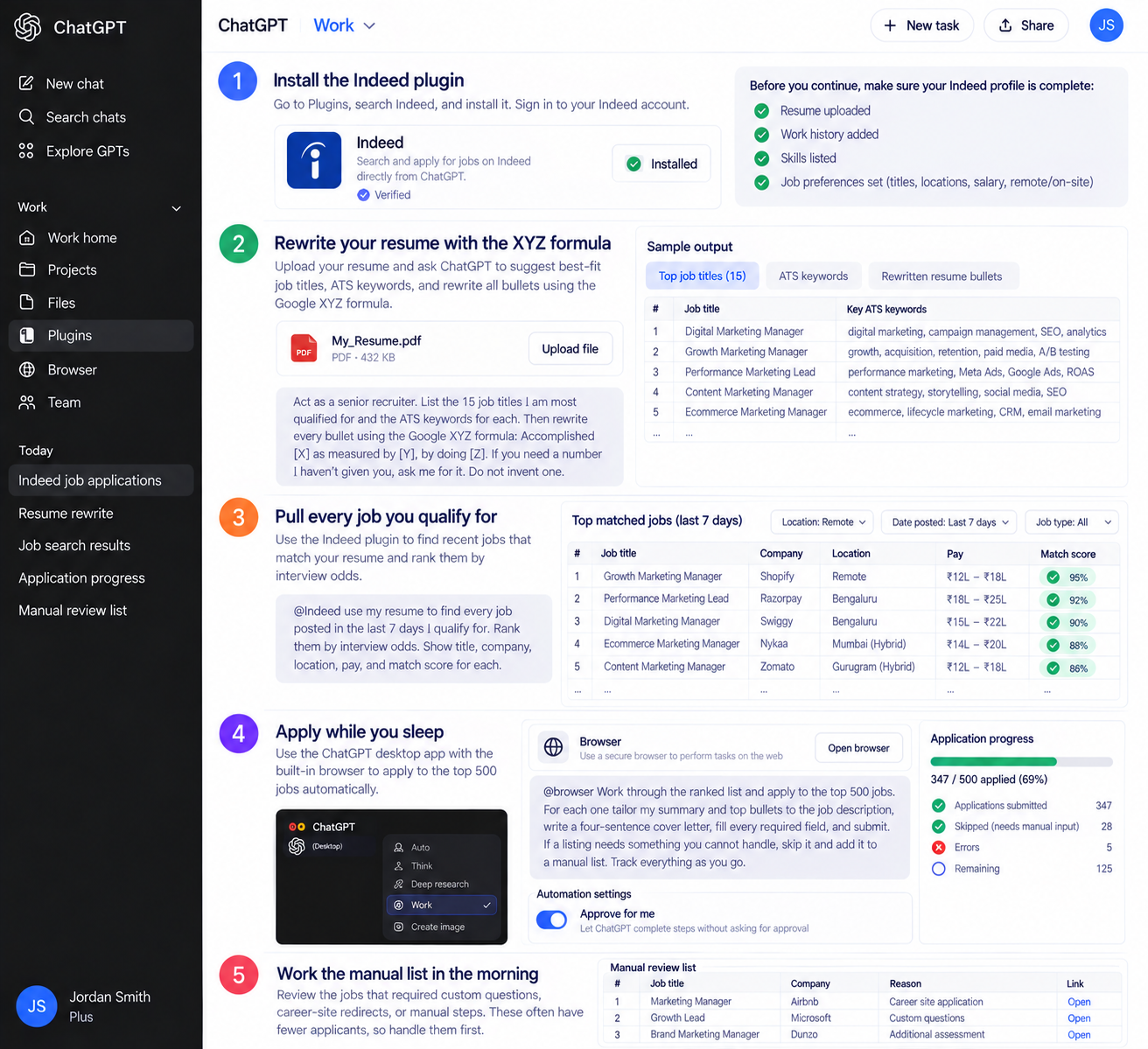
Step 1: Install the Indeed plugin - Open ChatGPT > Plugins > search Indeed > Install. Sign into your Indeed account when prompted. Done in 30 seconds. Make sure your Indeed profile has a resume, work history, skills, and job preferences filled in before anything else.
Step 2: Rewrite your resume with the XYZ formula - Upload your current resume and paste this:
“Act as a senior recruiter. List the 15 job titles I am most qualified for and the ATS keywords for each. Then rewrite every bullet using the Google XYZ formula: Accomplished [X] as measured by [Y], by doing [Z]. If you need a number I haven’t given you, ask me for it. Do not invent one.”
Then replace the resume on your Indeed profile. Every application goes out with whatever resume Indeed has stored — not the one in your chat.
Step 3: Pull every job you qualify for - “@Indeed use my resume to find every job posted in the last 7 days I qualify for. Rank them by interview odds. Show title, company, location, pay, and match score for each.”
Run it again with filters to narrow or widen until the top of the list looks right.
Step 4: Apply while you sleep - Open the ChatGPT desktop app, switch to Work, open the built-in browser, sign into Indeed, then run this:
“@browser Work through the ranked list and apply to the top 500 jobs. For each one tailor my summary and top bullets to the job description, write a four-sentence cover letter, fill every required field, and submit. If a listing needs something you cannot handle, skip it and add it to a manual list. Track everything as you go.”
Set permissions to “Approve for me.” Check the first ten cover letters before letting it run overnight. Plug the laptop in and turn off sleep mode.
Step 5: Work the manual list in the morning - Career-site redirects and custom questions land in the manual pile. These usually have fewer applicants work them by hand first.
🧠 Anthropic Co-Founder now predicts AI could improve itself by 2027
Anthropic co-founder Jack Clark has moved his prediction for recursive AI self-improvement from 2028 to 2027, citing new research showing how quickly AI models are improving at planning and conducting research.
The Shift:
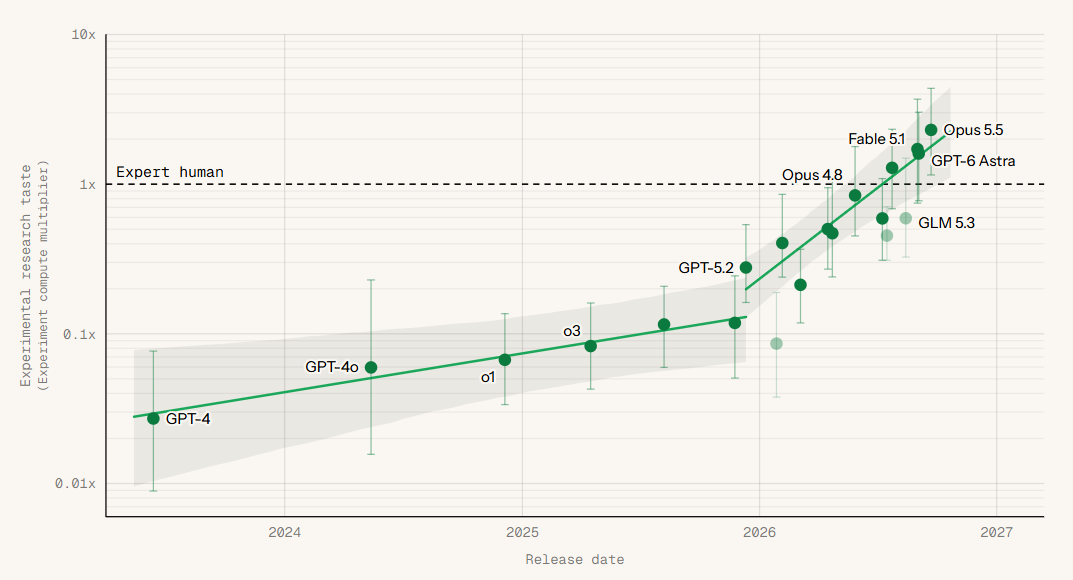
AI Research Skills Get Tested - P-Zero Research's TasteVal benchmark challenges AI models to design experiments for eight AI research problems, while a separate coding agent executes the work.
Claude Outperforms Human Researchers on Cost - Anthropic's Opus 5.5 led the benchmark, completing research attempts at roughly 30 times lower cost than a group of 24 experienced AI researchers from organizations including OpenAI and Google DeepMind.
Clark Moves His Prediction Forward - In May, Clark assigned just 30% probability to fully automated AI research by 2027, citing limitations in creative reasoning. New evidence has prompted him to bring forward his self-improvement timeline.
AI Coding Productivity Surges - Anthropic engineers report that daily code merges have increased more than tenfold since May, with Claude handling more programming work. They now say coding is no longer the company's main bottleneck.
AI's growing ability to plan research experiments could be more consequential than faster code generation alone. Clark's revised timeline suggests growing confidence in automated AI development, although strong benchmark results do not yet demonstrate a system capable of independently improving itself.
Together with Playbook Pro
Your Next 6 Months of Ad Spend Could Disappear in 6 Weeks

CAC is up 60% this year, and 70% of first-time buyers never return. Keep leaning on ads, and the budget you’re planning for the next half year could be gone before spring.
Rewriting the DTC Rulebook is the shortcut top operators are using to escape the trap, a 24-page report distilled from 200+ hours of real brand research and field tests.
Inside, you’ll learn how to:
🔥 Build emotional campaigns that double repeat-purchase rates in 90 days.
💰 Raise prices without losing volume using the Brand Value Canvas.
🧠 Cut 30% of paid-ad dependency with the Owned Media Checklist.
Download today and get 2,000+ viral video hooks already tested to grab attention in under 3 seconds, ready to plug into your next launch.
Stop feeding the ad machine.
Grab the free report now and lock in sustainable growth before your next dollar disappears!
🏆 Tools you Cannot Miss:
📱 PostNitro – Turns topics, articles, and text into branded social carousels, images, and animated posts, then schedules them across social platforms.
🎥 DemoScreen – Converts product screenshots into narrated demo videos with camera movements, music, captions, and 1080p exports.
🖼️ ImageFlow – Edits images and Photoshop PSD files in the browser with layers, masks, effects, and local processing.
🎬 EasyCut – Opens AI-generated motion videos as separate editable tracks for footage, titles, music, and sound effects.
✂️ OpenChatCut – Edits footage through text instructions, adding captions, music, cuts, and transitions to a timeline that creators can manually refine.
🚀 Quick Hits
🛍️ Shopify is opening its catalog of over 1 billion products to third-party AI shopping agents, allowing users to set budgets, filter shipping options, and complete purchases through Shop Pay, with approval required for every order.
⚠️ More than 400 AI researchers signed an open letter demanding stronger AI testing safeguards, urging companies to adopt high-assurance containment systems and establish an international body to track AI containment failures and unauthorized cyberattacks.
🔒 OpenAI and Anthropic reportedly considered restricting what independent AI safety evaluators could publish to protect trade secrets. Both companies maintain that reviewers retain disclosure rights, raising questions about transparency in AI safety assessments.
💻 Google is integrating Antigravity’s agentic coding interface into the Gemini app for Mac, allowing users to access AI-powered coding tools directly within Gemini. The feature is exclusive to Google AI Ultra subscribers.
🎯 Facebook introduced AI-powered feed controls that let users customize recommendations using natural-language prompts. Users can select topics, mark posts as interested or not interested, and see Feed and Reels recommendations update in real time.
👨💻 What’s trending on socials

🏠 Apple unveils its new homeview smart display - Apple introduced HomeView, its new smart home display, featuring a touchscreen interface for video calls, weather updates, media playback and smart home controls, with multiple color options showcased.
💛 Ithaca Announces Agreement to Acquire Bumble - Ithaca announced an agreement to acquire dating platform Bumble, aiming to integrate frontier AI technology to improve matchmaking and help users build meaningful relationships while maintaining a long-term ownership strategy.
⚡ Someone built AI models that run 200x faster - Someone introduced Constrained Decoding Models (CDMs) for classification, extraction and summarization, claiming 200x faster processing, 467x lower costs and support for 1 million input tokens at just $0.05 per million tokens.
🫧 Someone created photorealistic water bubbles using CGI - Japanese creator Yuki Ito shared a fully computer-generated animation of bubbles floating on water, created using Houdini. The realistic lighting, reflections and fluid details helped the video reach 1.6 million views.
Thanks for Decoding with us🥳
Your feedback is the key to our code! Help us elevate your Decode experience by hitting reply and sharing your input on our content and style.
Keep deciphering the AI enigma, and we'll be back with more coded mysteries unraveled just for you!