Microsoft wants agents running everything
Plus, 🧐How to track competitor moves in real time with Rocket Intelligence, Google is opening the black box around AI Search visibility, and more!

Hola Decoder😎
If someone forwarded this to you and you want to Decode the power of AI and be limitless, then subscribe now and Join Decode alongside 30k+ code-breakers untangling AI.
🤖 Microsoft wants to become the operating system for AI agents
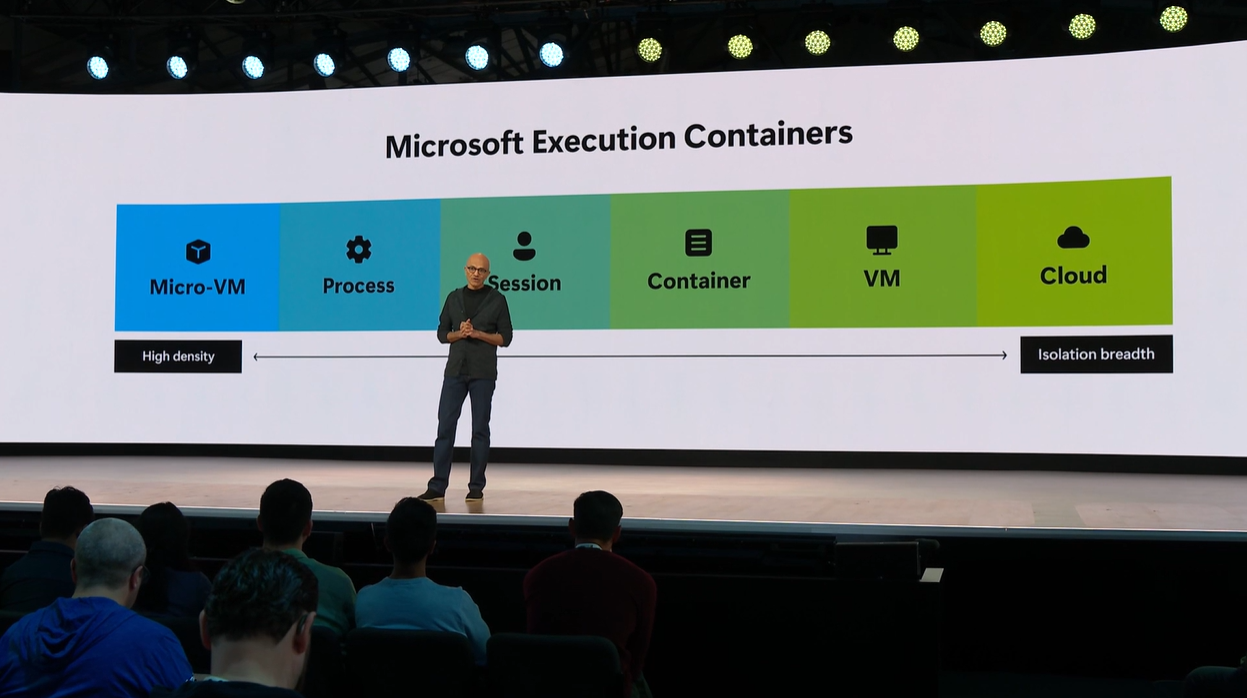
Microsoft used Build 2026 to unveil new models, hardware, agent tools, and developer platforms, all centered on a vision where AI agents become active participants across work, software, and computing environments.
The Decode:
Microsoft expands its AI lineup - Microsoft introduced seven new MAI models covering reasoning, coding, voice, image generation, and transcription, while launching Scout, its first always-on OpenClaw-powered agent for Teams.
Majorana 2 reaches milestone - unveiled Majorana 2, a quantum chip partly designed with AI assistance that delivers a reported 1,000x reliability improvement and could speed practical quantum computing timelines.
Local AI takes center stage - Microsoft launched Aion 1.0 Instruct and Aion 1.0 Plan for local reasoning and planning, positioning Windows and Microsoft 365 as the foundation for future agent workflows.
Enterprise knowledge gets connected - New Web IQ, Work IQ, Foundry IQ, and Fabric IQ systems provide agents with access to web information, company knowledge, development workflows, and business data.
New devices target AI workloads - Microsoft introduced the Surface RTX Spark Dev Box with 1 petaflop of AI compute and support for 120B-parameter models, while previewing Project Solara and future agent-focused devices.
Microsoft's strategy goes far beyond building chatbots or AI assistants. The company is betting that the next phase of AI will be won by whoever controls the environment where agents access data, use tools, collaborate with teams, and get real work done.
Together with Planable
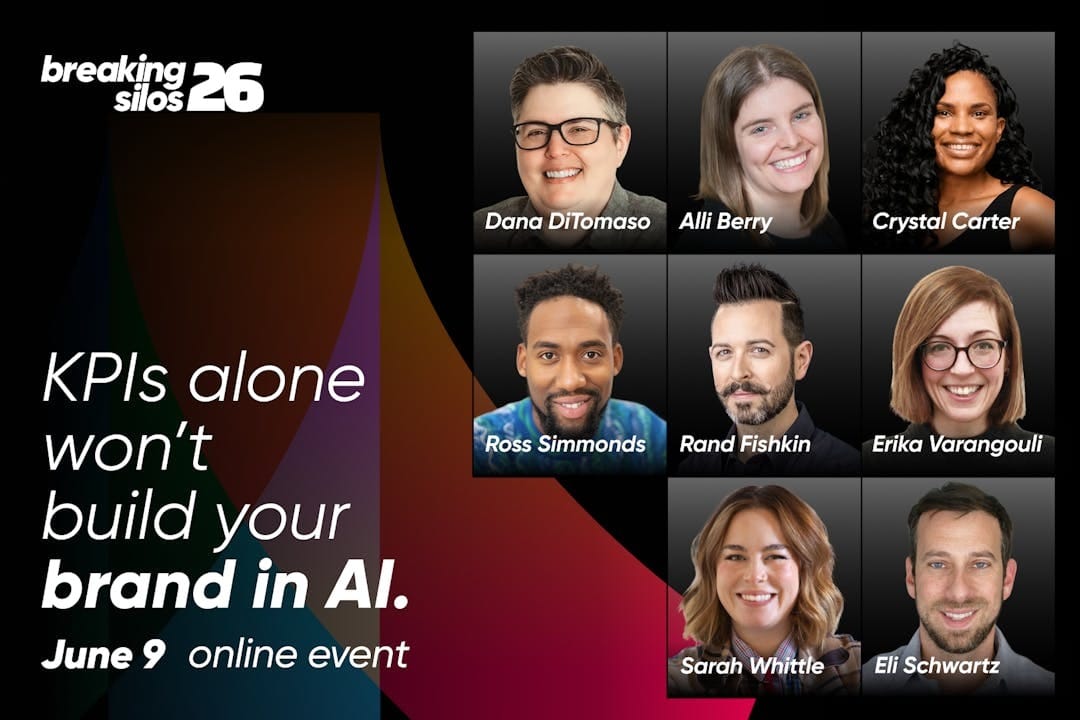
70+ practitioners cracked the AI visibility code. They're teaching it live.
A buyer chose a competitor last quarter because the AI recommended them. Not because of price. Not because of product. Because their brand showed up where the decision was already being made and yours didn't.
BreakingSilos 2026 is built for the leaders who don't want to find out that way. Free. Online. June 9th.
You'll walk away with:
- Which signals AI uses to decide which brands surface and which don't
- A strategy that connects your SEO, social, content, and PR so they build on each other
- The language to get your org moving on this before your competitors do
The people teaching this have already built it. Rand Fishkin (Co-Founder and CEO, SparkToro), Bogdan Babiak (CMO, SE Ranking), and Crystal Carter (Head of AI Search and SEO Communications, Wix) are among the practitioners on stage across 30+ sessions. Zero vendor pitches.
The frameworks here take months to figure out alone. You can skip that part.
Can't make it live? Register anyway and get the recording in your inbox within 24 hours.
🧐How to Track Competitor Moves in Real Time With Rocket Intelligence
A competitor just changed pricing. Shifted messaging. Started hiring for a new role. Rocket saw it before you did. Here's how to set it up.
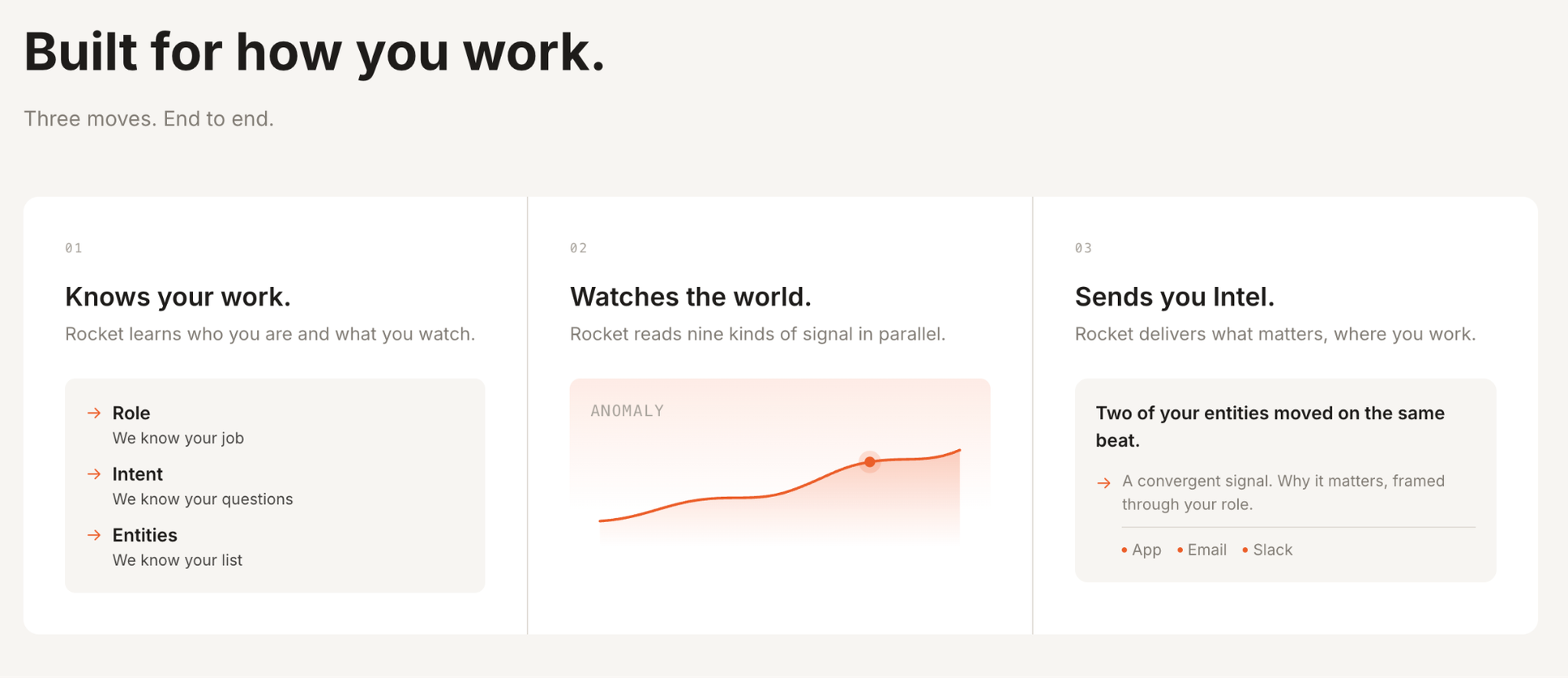
Step 1: Create your account Head to rocket.new/intelligence Free to start, no credit card required. Follow your first company in 30 seconds.
Step 2: Set your role and intent Tell Rocket who you are and what you're watching for. It uses this context to frame every signal through your specific job and goals, not generic alerts.
Step 3: Follow your competitors Add the companies you want to monitor. Rocket tracks nine signal types across web, social, hiring, product, news, and more, continuously, in parallel.
Step 4: Get Intel delivered where you work Rocket sends signals to your app, email, or Slack. When two followed entities move on the same beat, it flags the convergence and tells you exactly what it means and what to do next.
Step 5: Act on it Every Intel brief comes with a recommended next move framed to your role, not raw data you have to interpret yourself.
Knows your work. Watches the world. Sends you what matters. You can get started free here.
🏛️ AI policy battle takes shape
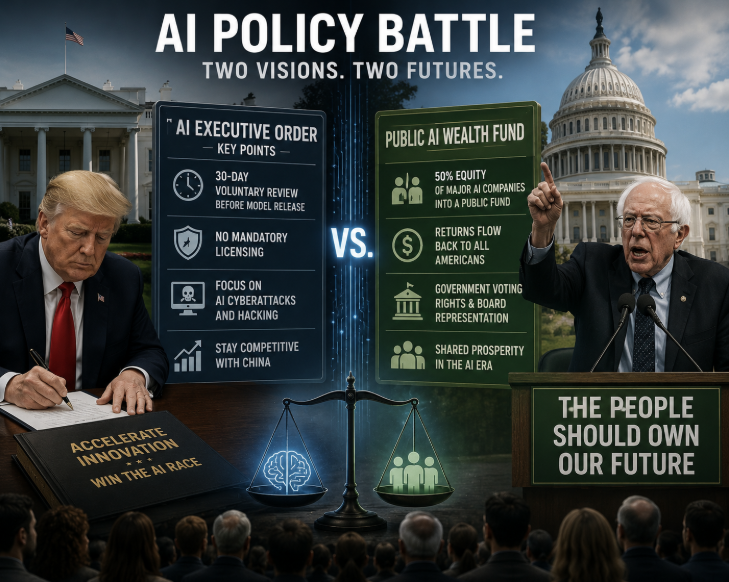
The U.S. government and lawmakers unveiled two very different AI proposals this week. One is focused on speeding model releases and staying competitive with China, while the other aims to give the public a direct financial stake in the AI boom.
The Decode:
🇺🇸 Trump scales back AI review plans
The Trump administration finalized an AI executive order that asks labs to voluntarily submit certain frontier models for a 30-day government security review before launch, cutting the originally proposed 90-day window.
The order also confirms there will be no mandatory licensing system for AI models, while directing federal agencies to focus enforcement efforts on AI-powered cyberattacks and hacking activity.
💰 Sanders proposes public AI fund
Bernie Sanders previewed new legislation that would place half the equity of the largest AI companies into a public sovereign wealth fund, with returns flowing back to Americans.
Sanders said the proposal would also give the government voting rights and board representation at major AI firms, arguing that the benefits of AI should be shared more broadly across society.
The conversation around AI is increasingly shifting from what models can do to who controls them and who benefits from their success. These proposals highlight two competing visions for the future of AI: faster innovation with limited oversight versus broader public participation in the industry's economic gains.
Together with Playbook Pro
Your Next 1,000 Customers Are Already Here

Pouring more money into ads won’t fix flat growth. The real leverage is hiding inside the customers you already have, and every day you wait, that momentum leaks away.
Networked Growth Engines is the 26-page field guide built from 200+ hours of research and real brand wins. It gives you ready-to-use systems you can plug in this week, no giant team or budget required. With it, you can:
🔥 Spark self-propelling communities using the Community Building Playbook, exactly how Nyfter built a 500,000-member Discord that drives product innovation.
📈 Design referral programs that fund themselves with the Referral ROI Calculator, the same loop that powered 34% of Blue Apron’s customer acquisition and delivered a 17.3× ROI for Latico Leathers.
🤝 Form trust-based partnerships fast using the Partnership MoU and 50-template Outreach Library to unlock new audiences without paid ads.
Your current customers are the growth engine.
Download the guide today and start compounding growth before another week of ad spend vanishes.
🏆 Tools you Cannot Miss:
📈 Natiad – Helps brands rank higher on Google and increase their chances of being cited by AI search engines like Gemini for long-term traffic growth.
🎙️ Cleanaudio – Removes background noise, echo, traffic sounds, and microphone hum to deliver studio-quality audio with one click.
🗣️ VoiceOS – Lets you control apps and complete tasks using voice commands to work faster and reduce manual effort.
🤖 AIsa – Provides the infrastructure AI agents need for reasoning, actions, payments, and deployment with pay-per-use pricing.
🏠 Manifest – Builds and manages a home inventory from photos, receipts, or voice notes while tracking warranties, recalls, insurance records, and resale value.
🚀 Quick Hits
💧 Google unveiled a plan to become water positive by 2030, pledging to replenish more water than its data centers consume, invest in local water infrastructure, and use alternative water sources as AI-driven data center expansion accelerates.
⚖️ The UK’s CMA ruled that Google must let publishers opt out of AI Overviews, AI Mode, and AI training, while requiring clearer attribution and links. Google has begun testing new publisher controls and plans a broader rollout.
👀 Meta has scaled back its Model Capability Initiative (MCI) after employee backlash. Staff can now pause tracking for up to 30 minutes, while employees handling sensitive content, working remotely, or facing device concerns can be exempt.
💸 Uber capped employee AI tool spending at $1,500 per month per tool after exhausting its entire annual AI budget in just four months.
🏢 OpenAI expanded Codex beyond coding, reporting 5 million weekly active users and 6× growth since February. It launched six enterprise-focused tools, plus new Sites and Annotations features for knowledge workers.
🧩 Prompt of the Day
Form Field Reduction That Increases Conversions
Most forms ask for more information than they need. Every extra field creates friction, increases abandonment, and reduces completion rates.
Turn your forms into fast, low-effort conversion paths.
Paste the prompt: Drop this into ChatGPT, then fill in your form details.
Prompt to paste
Create a form field reduction strategy for [Insert sign-up form, checkout flow, or lead capture page]. Audit all current form fields and classify each as essential, optional, or unnecessary. Identify opportunities to reduce data collection without impacting business goals, and recommend a streamlined version of the form. Explain how each removed field could improve completion rates, user experience, and conversions. Focus on minimizing friction while still capturing the information needed for sales, fulfillment, or customer onboarding.
🤳AI Nugget of the Day
Thanks for Decoding with us🥳
Your feedback is the key to our code! Help us elevate your Decode experience by hitting reply and sharing your input on our content and style.
Keep deciphering the AI enigma, and we'll be back with more coded mysteries unraveled just for you!