
Anthropic Pushes Beyond Chatbots
Plus, ✨How to generate and edit images for free with HiDream-O1, Cursor trained Composer using dramatically larger synthetic coding task datasets, and more!


Hola Decoder😎
If someone forwarded this to you and you want to Decode the power of AI and be limitless, then subscribe now and Join Decode alongside 30k+ code-breakers untangling AI.
🧪 Anthropic and SandboxAQ expand beyond chatbots
Anthropic and SandboxAQ announced major updates focused on scientific AI and developer infrastructure, with SandboxAQ bringing advanced research models into Claude while Anthropic tightened control over AI agent integrations through its Stainless acquisition.

The Decode:
Scientific models become conversational - SandboxAQ integrated its quantitative scientific AI models directly into Claude, allowing researchers to run advanced drug discovery and materials science workflows through simple natural language interactions.
Researchers no longer need infrastructure - SandboxAQ said users previously needed specialized computing environments to access these systems, but Claude now removes much of the technical complexity around scientific model deployment and experimentation.
Developer infrastructure moves in-house - Anthropic acquired Stainless, the SDK automation startup used by OpenAI, Google, Cloudflare, and other rivals, giving Anthropic deeper control over critical AI developer infrastructure tooling.
Anthropic closes ecosystem loop - Anthropic said Stainless will wind down hosted products for outside companies, meaning infrastructure previously shared across the AI industry will now become tightly integrated into Anthropic’s own ecosystem.
AI companies are increasingly competing far beyond chatbot quality alone. The race is now shifting toward owning developer infrastructure, scientific workflows, enterprise tooling, and the systems researchers depend on behind the scenes.
Together with AirOps
Your buyers moved to AI search. Your content didn't follow.
52% of adults now research on ChatGPT, Gemini, and Perplexity. Those visitors convert at 4.4x the rate of organic search, and 83% of the citations they see go to pages updated in the last 12 months.
You're not losing to better content. You're losing to better structure, fresher pages, and off-site signals you haven't touched yet.
AirOps analyzed 15M+ AI queries and built the playbook content teams are using to close that gap right now. Inside you’ll find:
- Structural patterns that make your content easy for AI engines to extract and cite
- Refresh cadences and off-site signals that keep you visible as algorithms shift
- Team models and a 90-day action plan you can run this Quarter.
Teams at Carta, Ramp, Webflow, and Klaviyo are already running this playbook to win AI search visibility and pipeline.
✨How to Generate and Edit Images for Free With HiDream-O1
An open source image model with word accuracy on par with GPT-Image-2 and Nano Banana. 8B parameters. MIT License. Here's how to use it.

Step 1: Try it instantly on Hugging Face - No setup needed. Head to the hosted demo and start generating immediately, no GPU, no install, no account required.
Step 2: Generate from text - Describe your image in plain language. HiDream-O1 handles photorealism, long text rendering, diagrams, ads, and posters with strong prompt adherence out of the box.
Step 3: Edit existing images - Upload an image and describe what to change. Add, replace, or remove elements directly, no manual masking or inpainting tools needed.
Step 4: Generate storyboards - Feed in a sequence of prompts and let HiDream-O1 build consistent scene-by-scene visuals automatically.
Step 5: Run it locally - Download the model from Hugging Face and self-host for unlimited generation with zero API costs. MIT license, use it commercially, modify it, build on it.
8B parameters. On par with closed-source models that cost orders of magnitude more to run. You can try the demo here. or download the model here.
🧠 Cursor upgrades Composer for longer AI coding workflows
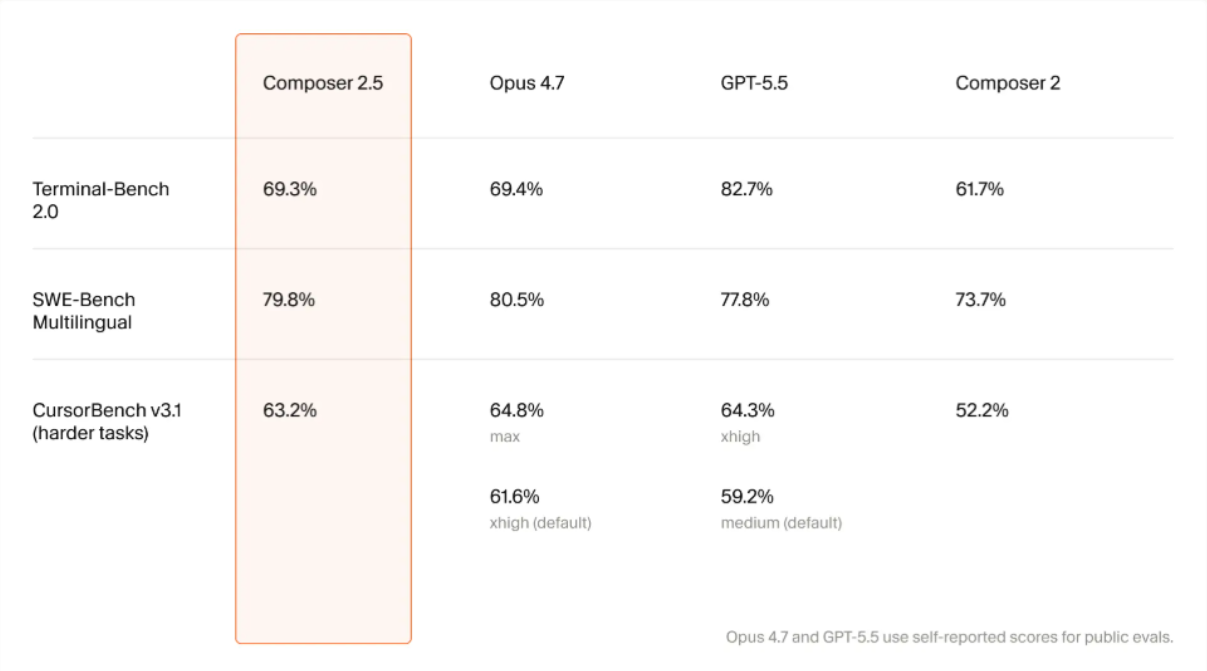
Cursor released Composer 2.5, a major update to its coding model focused on improving long-running task execution, instruction following, communication quality, and reinforcement learning behavior across complex software workflows.
The Decode:
Cursor improves coding reliability - Cursor said Composer 2.5 performs better on sustained coding sessions, handles complex instructions more reliably, and improves collaboration behavior during longer multi-step software development workflows.
Composer undercuts frontier rivals - Cursor said an average CursorBench task costs under $1 using Composer 2.5, compared to reportedly reaching around $11 for Opus 4.7 and GPT-5.5 at similar performance levels.
Training complexity increased sharply - Composer 2.5 was trained using 25x more synthetic coding tasks than Composer 2, including feature deletion challenges built from real-world codebases and functional software testing systems.
Larger model training begins - Cursor revealed Composer 2.5 was partially trained using Colossus 2 infrastructure, while also training a significantly larger SpaceXAI model using roughly ten times more compute resources.
AI coding models are becoming increasingly autonomous during long software workflows instead of only responding to isolated prompts. The bigger challenge now is not just improving capability, but controlling unexpected behaviors emerging during advanced reinforcement learning training.
🏆 Tools you Cannot Miss:
🚀 UGO – Automatically creates social posts, blogs, SEO pages, and ad campaigns using content tailored to your actual brand voice.
🎵 MusVideo – Turns uploaded audio into cinematic AI-generated music videos without requiring editing or directing skills.
🎬 Flyne AI – Converts photos into engaging AI-generated videos for content creation and storytelling.
💇 Silky AI – Lets you instantly try different hairstyles with AI before making a real-life change.
📹 Vidlogi – Generates fully produced SEO-focused videos from prompts or trending ideas, ready to upload in one workflow.
🚀 Quick Hits
📱 Apple is reportedly adding Grammarly-style AI writing assistance to iPhone and iPad, alongside AI-generated wallpapers, smarter Shortcuts automation, and a rebuilt Siri experience in upcoming updates.
⚡ A new U.S. bill from Sen. Adam Schiff aims to stop households from absorbing energy costs tied to AI data centers by placing stricter requirements on high-power AI infrastructure projects.
⚖️ Elon Musk lost his case against Sam Altman and OpenAI after a jury found key claims were blocked by statute-of-limitations rules, though Musk says he plans to appeal.
🎙️ Amazon’s Alexa Plus can now generate AI podcasts on nearly any topic, using synthetic hosts and news sources to create customizable audio explainers directly inside Alexa.
🏢 OpenAI partnered with Dell to bring Codex into corporate data centers, letting enterprises run AI coding agents closer to sensitive internal systems, repositories, and workflows in hybrid or on-premise environments.
🧩 Prompt of the Day
Lookalike Audience Strategy That Finds Better Customers
Most lookalike audiences fail because the source audience is weak. High-performing campaigns start with the right customer signals and scale from proven buyers.
Turn your best customers into a scalable acquisition engine.
Paste the prompt: Drop this into ChatGPT, then fill in your audience and platform details.
Prompt to paste
Create a lookalike audience strategy for [Insert brand or product]. Identify the best source audience using data such as high-LTV customers, repeat buyers, or top converters. Recommend ideal audience sizes and expansion percentages for testing and scaling across platforms like Meta, Google, or TikTok. Analyze the key traits, behaviors, and interests shared by top customers, and explain how to structure campaigns around these segments to improve conversion rates and customer quality.
🤳AI Nugget of the Day
Thanks for Decoding with us🥳
Your feedback is the key to our code! Help us elevate your Decode experience by hitting reply and sharing your input on our content and style.
Keep deciphering the AI enigma, and we'll be back with more coded mysteries unraveled just for you!